
Letter From Oomf #3
A decongested daze and the limits of story telling

Currently writing on a somewhat empty stomach and decongestants so apologies for any meandering, but I really wanna talk about SLC Punk (1999), cycles, and the future (not mine).
*Minor Spoilers for SLC Punk ahead*
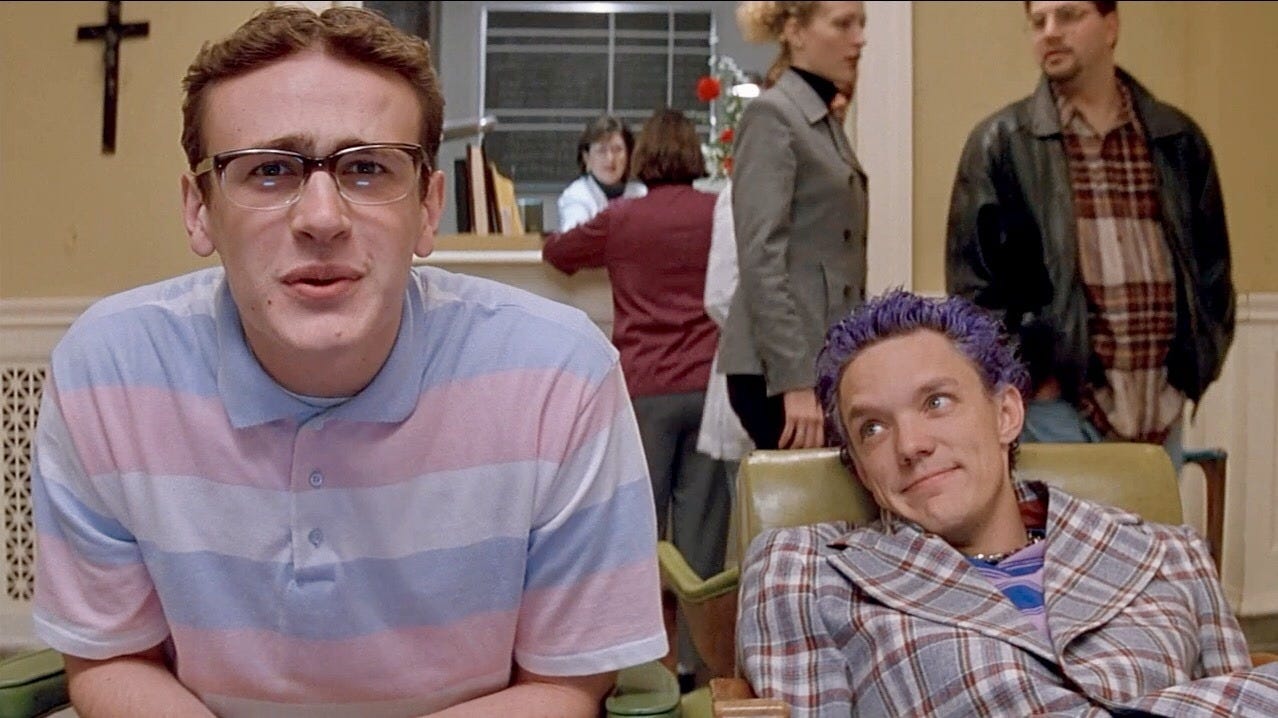
A few days ago, I rewatched SLC Punk. I had first seen it about a year or two ago and thought it was a cool little coming of age movie with stereotypical looking punks. On the nose and corny with its story beats, but packed with a lot of heart and great acting. The movie whacks you over the head with Matthew Lillard’s fast narration, especially when he gets philosophical. I honestly did not catch nor understand much when he spoke that way and chalked it up to his character’s personality being a sort of smart pseudo-intellectual. He is a college grad after all.
On a rewatch, I was able to catch and understand a lot more of what Lillard was saying in his narration bits. Two major bits really stuck out to me. The first being his rationalization of the punk “fight” and its contradiction with being an “Anarchist.” He explains how the punks fight the rednecks, the rednecks fight the mods, the mods fight the new wavers, etc. He also explains how they do this in defense of their strong beliefs, such as Anarchy. After he lays that groundwork down he quickly explains how the fighting is nothing more than a micro-version of the wars governments wage. He says that fighting is power, power to defend a system, but to Stevo (Lillard) Anarchy means that there should be no system at all!! With this contradiction in mind, Stevo shrugs it off and returns to fighting. A womp womp irony moment to make the audience scoff.

Stevo rationalizes towards order then cycles back to disorder. He believes everything is or should be chaos. Towards the end of the movie, Stevo has a debate with a former punk turned strange hippie/mod type beat over whether Stevo’s Anarchy/disorder is really how things are. The strung out friend (stroomf if you will) talks over Stevo explaining how nothing is ever just “order” or “disorder.” To him life and existence cycle from order-disorder-order-disorder. This is the second part that stuck out to me. Stevo doesn’t know how to respond to anyone challenging his beliefs like that and we fade into the next scene that further proves everyone’s point that Stevo’s “Anarchy” just MIGHT be wrong.
To be clear, I really don’t think this movie has anything “deeper” to say about these things, but I just found it interesting to see the life cycle of a good ol’ fashioned punk from order-disorder. I’m also no expert on philosophy, in fact those classes were my least favorite and my lowest grades. With that said, I’m pretty sure Stevo is confusing Anarchy with some other idea, not sure if that’s supposed to be another womp womp irony moment or not though. Either way it got me thinking about the cycles we’ve seen in movies/story-telling as a whole.

Thinking about recent Oscar winners and just overall popular movies about very intense topics like Oppenheimer and Killers of the Flower Moon. Two movies which I liked, both were biopics that in a twisted way try to make you feel some type of way towards the main character, even though we’re sitting through close to three hours of them being a monster or a horrible push-over.
We know that in the grand-scheme of things, they are the bad guys even if we don’t always get to see the devastation they leave in their wake. I think the form of the “biopic” or even this kind of “story” does not allow for us to get the full picture here. The feelings and experiences of the “others” or victims in these movies only serve to propel the troubled nature/story of the perpetrator. To further put us in their shoes. Shoes mostly full of white-guilt.
That’s not to say that those forms of art are “bad art,” but I do think its getting old. Both of those movies are great and I left the theater shaken after both, however, I think audiences are becoming more aware of the limits these stories have. Some writers like the ones behind The Curse try to remedy this limitation by becoming meta or by giving the bad-guy main character a taste of what its like to go through something that makes no sense and not be listened to. I think this resistance to the traditional “main-guy bad” trope and maybe even the film industry as a whole is a sign of a new cycle brewing underneath the surface. Maybe disorder is eminent for the entertainment industry in a post-strike and post-AI world. It’s not necessarily a bad thing either (minus the AI stuff, that stuff is pretty bad). Most deconstructions of the entertainment world end up leading to more diverse groups of people telling their stories, hopefully this time leaving the white-guy-guilt trope behind.

The strike along with big budget box-office flops are signs that this system is just not working anymore. There are young people on tik tok making short of professional edits while big movie companies can’t seem to get people in the theater for their newest MCU addition.
This isn’t saying that tik tok “brain-rot” is the future, but I do think there is a world where the elements and fluidity of online creation are incorporated in the movie industry. Right now it sucks and a lot of online amalgamations are laughable, but the idea of normal everyday people being able to participate in the arts is the very idea that drew audiences to middle-class directors like Martin Scorsese in the first place!!! “Where have all the middle-class directors gone?” They’re probably online dude idk.
All this to say that I think and hope a shift like this happens soon. Everyone hates the Oscars and everyone hates the “low-brow” movies in the theaters (specifically my Mom who loves movies so if she doesn’t wanna go anymore that’s really saying something). It hit me how shot to shit normal town theaters are when I suggested that my mom go see Problemista, a brand new indie movie from the biggest indie distributor right now, A24, but the nearest showing was nearly an hour drive for her at like 11am…this was opening week for the movie too. That’s probably more related to capitalism and the idea of art competing in theaters…which the internet definitely plays a roll in when it comes to competition for attention…I could go on but its lurnch time.
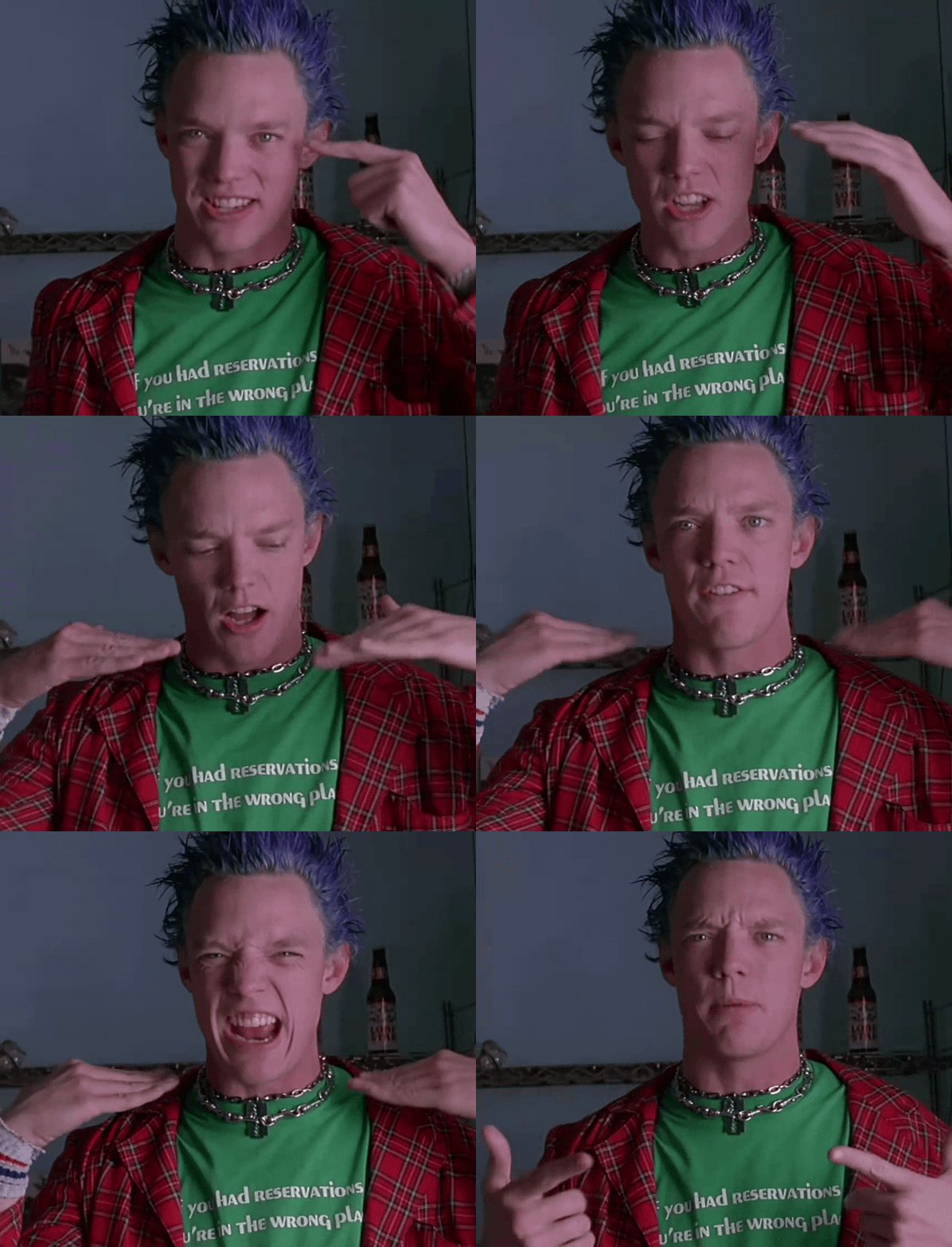
“Final summation? None.” — Stevo
Sincerely,
Decongested Oomf
Love the way you think ♥️♥️